Why neighbourhood choice matters for team building
In Amsterdam, the neighbourhood you choose shapes everything about the event: the visual backdrop, the density and character of the puzzles, the walking distances, the transport options getting there, and the post-event choices for food and drinks. A Treasure Hunt in the Jordaan feels fundamentally different from one starting at Dam Square — even if the puzzle mechanics are identical.
The five central districts covered here each have a distinct character. Understanding that character before you book helps you match the environment to your group's expectations — and avoid the common mistake of choosing a neighbourhood based on what you know rather than what fits the group.
Neighbourhoods at a glance
Quick comparison before the detail:
| Neighbourhood | Best group size | Atmosphere | Best season | Post-event options |
|---|---|---|---|---|
| Canal Ring | Any (9–300+) | Iconic, photogenic, layered | All year | Brown cafés, canal-side terraces |
| Jordaan | 9–60 | Quiet, local, residential | All year | Independent restaurants, hofje courtyards |
| Old Centre | Any — schedule carefully | Dense, historic, high-energy | Oct–Apr (avoid peak summer crowds) | Wide range — busy and touristy |
| De Pijp | 9–80 | Vibrant, multicultural, market | Spring–Autumn (market) | Albert Cuyp Market, global food scene |
| Museum Quarter | 30–300+ | Elegant, spacious, prestigious | All year | Vondelpark, upscale restaurants |
Canal Ring (Grachtengordel) — the versatile classic
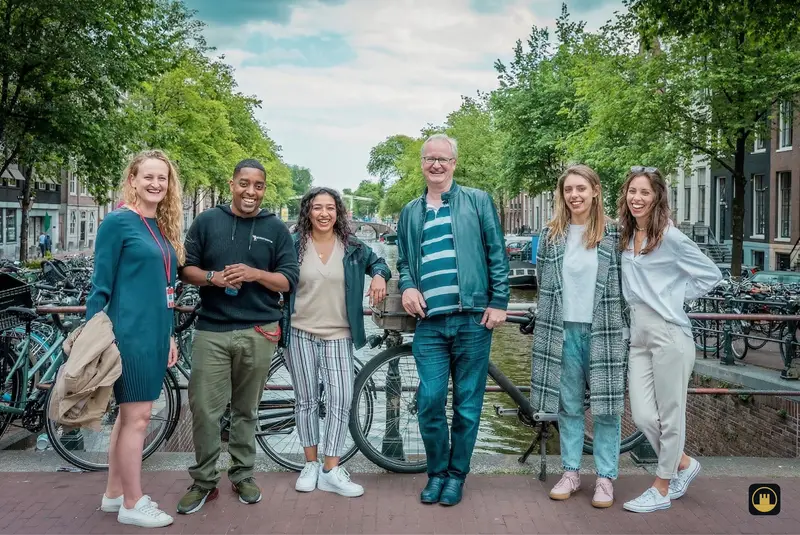
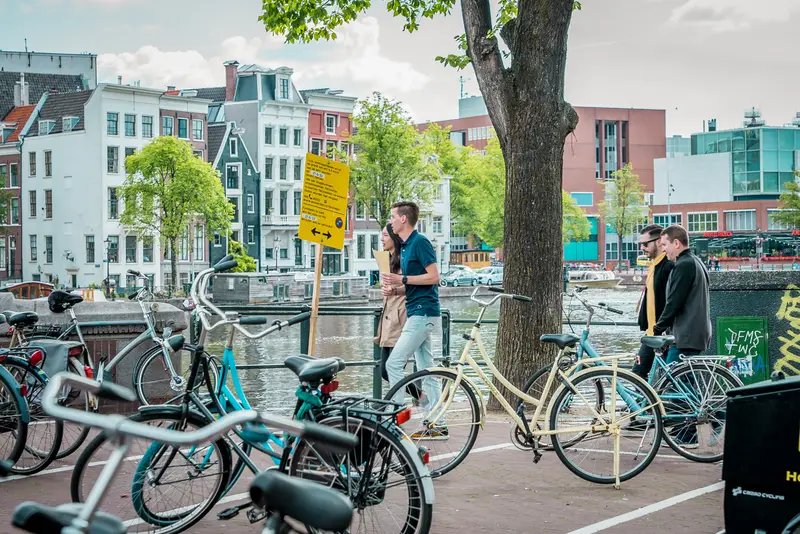
The UNESCO-listed Canal Ring is Amsterdam's most photographically iconic area — the gabled canal houses, the arched bridges, the dappled reflections on the water. For most international corporate groups, this is the first visual association with Amsterdam, which makes it a natural fit for orientation and cultural integration events. Groups from outside the Netherlands consistently rate the Canal Ring as the backdrop that most felt like "Amsterdam."
The Canal Ring's concentric structure (Herengracht, Keizersgracht, Prinsengracht) creates natural "levels" that work well for progressive puzzle design. Teams can orient themselves using the canals as landmarks, which adds a navigational layer without GPS dependency — a useful feature for groups who want a more immersive experience.
Transport access is excellent: trams 2, 11, 12 run along the major canals; Central Station is within walking distance of the northern Canal Ring. Most groups from Amsterdam hotels or offices can reach the start point on foot or by a single tram.
Best for: International groups, first visits to Amsterdam, cultural integration events, groups of any size.
Walking distance: Typically 4–5 km over 2.5–3 hours.
Post-event: Brown cafés (bruine kroegen) along Prinsengracht or canal-side terraces on Keizersgracht.
Jordaan — intimate and local
The Jordaan is where Amsterdammers actually live. Its network of narrow side streets (dwarsstraten), hidden courtyards and small squares (the Noordermarkt, the Lindengracht) feels entirely different from the tourist-heavy canal waterfront. For groups that want to see "real Amsterdam" rather than the postcard version — or for groups making a return visit who already know the Canal Ring — Jordaan consistently surprises people.
The neighbourhood rewards observation. The street art, the hofjes (hidden almshouse courtyards accessible through unmarked doorways), the guild symbols carved above doorways, the independent bookshops and wine bars that look unchanged since the 1970s — these are excellent puzzle anchors. The Jordaan also tends to be quieter than the Canal Ring, which means easier team communication and less background noise during briefings and clue-reading.
The compact geography — roughly bounded by Prinsengracht, Brouwersgracht, Lijnbaansgracht and Leidsegracht — means routes stay interesting without excessive walking.
Best for: Smaller groups (9–60), discovery-focused programmes, return visitors, groups wanting a less touristy experience.
Walking distance: 3–4 km, more compact than the Canal Ring.
Post-event: Café 't Smalle on Egelantiersgracht, or the terrace at Café de Prins.
Old Centre (Centrum) — maximum impact, maximum footfall
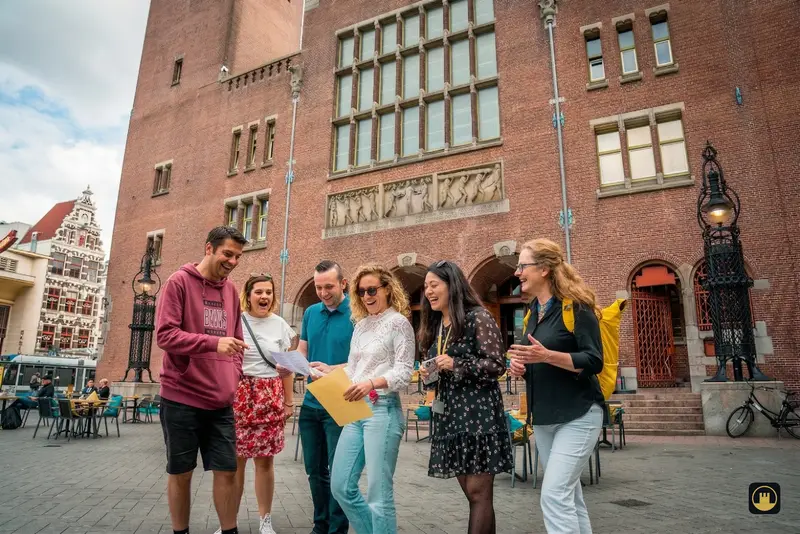
Dam Square, Rokin, the Begijnhof (a hidden medieval courtyard most visitors walk past without knowing it exists), the floating flower market on Singel. The Old Centre is the heart of Amsterdam's tourist density — which means iconic sights and exceptionally rich puzzle material, but also more people and more noise. For groups arriving in Amsterdam for the first time, the sheer recognition factor creates immediate engagement that other neighbourhoods can't match.
The city's original 13th-century core means historical layers going back further than almost anywhere else in the Netherlands. Puzzle material — inscriptions, guild houses, the original city boundaries, the Amstel dam itself — is exceptionally dense. The trade-off is navigation complexity in peak season: summer afternoons in the Old Centre can be genuinely crowded, and groups need to move with purpose rather than linger.
For international visitors making a single day trip to Amsterdam, the Old Centre justifies itself on brand recognition alone. For a team that knows the city, it's less compelling than the alternatives.
Best for: International visitors, orientation events, groups who want maximum Amsterdam impact.
Timing note: Schedule for morning start (10:00) or late afternoon (16:00+) to avoid peak tourist crowds in July–August.
Post-event: Heads south toward Leidseplein or east toward Nieuwmarkt for less touristy bar options.
De Pijp — vibrant and multicultural
De Pijp was historically a dense working-class neighbourhood; today it's one of Amsterdam's most diverse and energetic districts. The Albert Cuyp Market — the largest street market in the Netherlands, running for over a kilometre — is at its centre, surrounded by independent cafés, global food vendors, street art and an energy that feels distinctly different from the canal-district Amsterdam.
For food-integrated events — where the Treasure Hunt transitions into a market tasting, a street food experience, or a set menu at one of De Pijp's many international restaurants — this neighbourhood is the natural choice. The multicultural character also resonates particularly well with international corporate groups who find the canal districts familiar from tourism but want to see a different side of the city.
De Pijp is also the most Instagram-friendly neighbourhood for groups who want to document the event: the market, the street art along Ferdinand Bolstraat, and the neighbourhood's characteristic mix of old and new all photograph well.
Best for: Groups who want food integration, creative and international teams, afternoon events leading into dinner, groups aged 25–40.
Highlight: The Albert Cuyp Market is open Monday–Saturday until approximately 17:00.
Post-event: Brouwerij Troost (craft brewery on Cornelis Troostplein) or any of the restaurants along Frans Halsstraat.
Museum Quarter (Museumkwartier) — elegant and spacious
The Museum Quarter — centred on Museumplein with the Rijksmuseum, Van Gogh Museum and Stedelijk — offers the most physically spacious setting of Amsterdam's central districts. The wide boulevards and open square (Museumplein itself is one of the largest open spaces in the city centre) work well for larger groups who need room to spread out without feeling cramped or clustered.
The area's mix of world-class art institutions and 19th-century architecture (the Concertgebouw concert hall, the Vondelpark immediately to the north) suits executive-level events and situations where visual prestige is part of the brief. Groups from professional services, finance and consulting consistently respond well to the Museum Quarter's composed, less chaotic atmosphere versus the bustle of the Old Centre or Canal Ring.
For large groups of 100 or more, the Museum Quarter's open spaces also make logistics simpler — large groups can assemble, be briefed and split into teams without the pedestrian congestion that affects the same exercise in the Old Centre.
Best for: Larger groups (50–300+), executive events, groups wanting a more composed, less chaotic setting.
Walking distance: 4–5 km, Vondelpark loop option extends to 6 km.
Post-event: Vondelpark terrace at Café Vertigo in good weather; Leidseplein restaurants for covered options.
For more on choosing the right timing and logistics for your Amsterdam event, the planning guide covers the practical decisions that affect all neighbourhoods equally.