What the research says about environment and memory
Memory encoding is strongly tied to context. Experiences that happen in novel, multi-sensory environments — new sights, fresh air, physical movement, unexpected stimuli — are encoded more vividly and retrieved more reliably than experiences in familiar indoor settings. This is known as context-dependent memory: we remember not just what happened, but where and how it felt to be there.
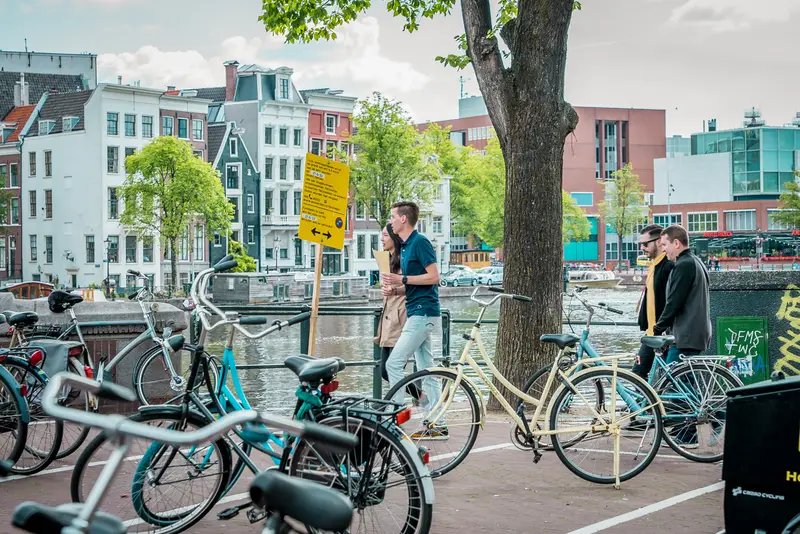
This has direct implications for team building. An activity conducted in Amsterdam's canal streets creates a richer, more specific memory than the same activity in a conference room or event venue. The cobblestones, the canal reflections, the smell of fresh air, the decision made at a bridge junction — these sensory details become woven into the memory of the people involved. That memory is what you are actually investing in when you organise team building.
Outdoor environments also introduce mild unpredictability — a sudden bridge closed for renovation, unexpected weather, navigation disagreements — that indoor formats can't manufacture. That unpredictability, handled well, creates the moments people talk about for months. It's the difference between an event that was "nice" and one that generated actual stories.
The honest case for outdoor
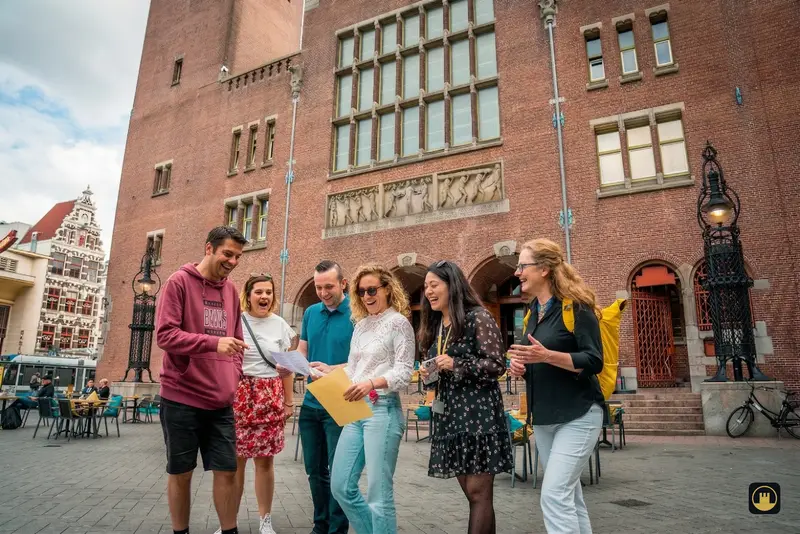
When conditions allow, outdoor team building in Amsterdam offers advantages that indoor formats can't replicate:
- Natural spatial separation: Teams spread across city blocks, which prevents the crowding and performance anxiety that indoor venues sometimes create. You get genuine privacy for team discussion — no neighbouring team overhearing your strategy.
- Physical movement: Walking 4–5 km over 2.5 hours provides a physical break from desk-bound work that most office teams genuinely appreciate. Moderate physical activity consistently improves mood and cognitive flexibility — both useful for the social interactions you're trying to encourage.
- Authentic city context: Using Amsterdam itself as the game board creates richer puzzles and more specific shared memories than any venue can provide. The canal district doesn't need decoration — it already is the experience.
- No venue cost: Outdoor activities require no venue hire, which typically reduces the all-in cost per person by €20–40 compared to equivalent indoor formats with venue fees.
- Scalability: Outdoor formats scale to 300+ people simply by adding parallel routes and game masters. Indoor venues have hard capacity limits. For large group events, outdoor is almost always the more practical choice.
The honest case for indoor
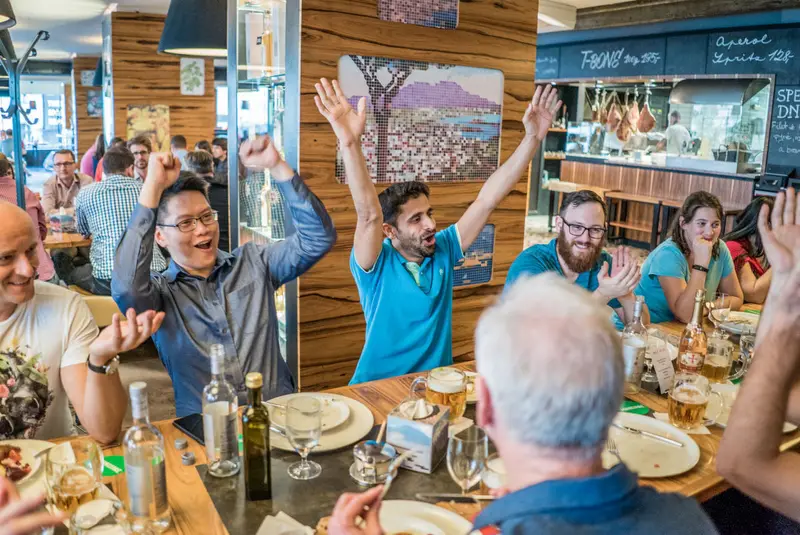
Indoor formats have legitimate advantages in specific situations — and it's worth being honest about when they're actually the better call:
- Weather certainty: If your event is in December, January or February and weather is genuinely unpredictable, an indoor format eliminates the rain risk entirely. Not everyone finds light rain acceptable, and forcing reluctant participants into bad weather undermines the whole point.
- Accessibility: If a significant proportion of your group has mobility restrictions, indoor venues can be configured for full participation without route adaptation. Amsterdam's cobblestones are manageable but not trivial for everyone.
- Evening events: Post-work events starting at 18:00+ are better suited to indoor formats in autumn and winter, when darkness and cold substantially change the outdoor experience. The warmth and light of an indoor venue becomes a feature rather than a limitation.
- Presentation-heavy events: If your event combines team building with a company presentation, award ceremony or structured training session, an indoor venue provides the AV infrastructure and seating configuration that outdoor formats simply can't accommodate.
Outdoor vs indoor: side-by-side comparison
| Criterion | Outdoor | Indoor |
|---|---|---|
| Memory strength | High — multi-sensory, novel context | Medium — controlled but familiar |
| Weather dependency | Yes — needs contingency Nov–Mar | None |
| Scalability | 9–300+ with parallel routes | Capped by venue capacity |
| Cost per person | Lower — no venue hire | Higher — venue fee adds €20–40 pp |
| Accessibility | Adaptable — confirm with provider | Full control over environment |
| Evening use (Oct–Mar) | Limited — darkness by 17:00 | No limitation |
| AV / presentation | Not suitable | Full infrastructure available |
Amsterdam weather: the realistic picture
Amsterdam's climate is oceanic — mild, cloudy and frequently damp. The city averages 750 mm of rainfall per year, spread fairly evenly across all months. What this means in practice is light drizzle rather than heavy downpours, and outdoor events in light rain are entirely normal. The realistic outdoor window:
- April–October: Generally suitable for outdoor events. May–September is the reliable core season with temperatures of 15–23°C and the longest daylight hours. April and October are workable with a contingency plan.
- November–March: Possible but requires preparation. Short days (sunset by 16:30 in December) limit afternoon programmes. Light rain is common; heavy rain and strong wind are the exceptions, not the rule. A morning start (10:00–13:00) is strongly recommended.
The Dutch approach to rain is pragmatic: dress for it and continue. Most professional outdoor event providers in Amsterdam run events in light rain without issue, and experienced providers will contact you 24–48 hours before the event if heavy weather is forecast to discuss contingency options. For neighbourhoods with good rain shelter, the Jordaan and Museum Quarter offer better covered options than the open Canal Ring waterfront.
A practical decision tree
Use this to guide your choice — most groups will land in the outdoor column:
- Event in April–October, no mobility restrictions → outdoor, no contingency needed
- Event in April–October, mixed mobility needs → outdoor with adapted route — confirm with provider
- Event in November–March, daytime start → outdoor with rain plan agreed in writing
- Event in November–March, evening start → indoor or hybrid (outdoor activity ending at indoor venue)
- Significant mobility restrictions → discuss adapted outdoor or fully indoor
- Presentation or ceremony required → hybrid: outdoor activity + indoor reveal/presentation
- Group dislikes physical activity / weather → indoor — don't force outdoor on a reluctant group