The problem with large-scale team building
Most corporate team building formats have an invisible ceiling. Escape rooms work for 8–12 people. Cooking classes top out at 40–50 before the venue becomes crowded and facilitation quality drops. Improv workshops work well for 20 but feel performative above 30. Even simple pub quizzes become logistically messy above 80. The pattern is consistent: formats designed for small groups degrade at scale rather than simply getting bigger.
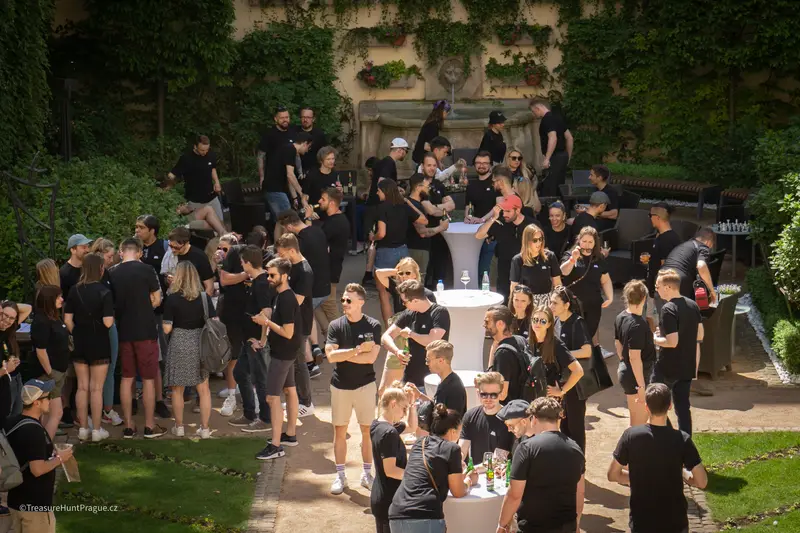
The result is that large corporate groups default to passive formats — a conference dinner, a company presentation, a drinks reception — that provide shared presence but no genuine team interaction. Everyone experiences the same evening, but nobody interacts outside their existing clusters. The opportunity cost is significant, particularly for organisations where cross-department connection is a stated priority.
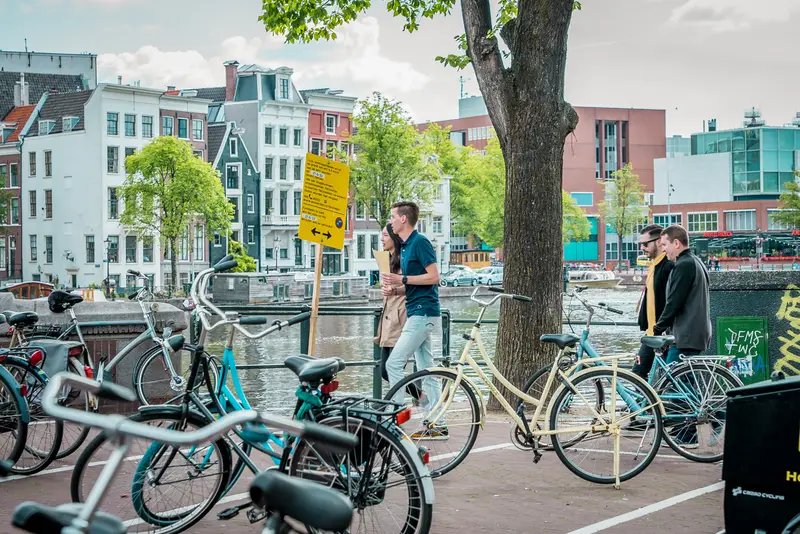
Outdoor city-based formats are a genuine exception. A Treasure Hunt scales from 9 to 300+ by design, because the city itself absorbs the volume. Instead of crowding a venue, you spread across canal streets. Each team of 5–6 operates semi-independently, and the competitive structure creates interaction between people who might never otherwise talk. The key mechanism — a shared convergence and score reveal at the end — ensures the full group shares a climax moment regardless of how many routes ran in parallel.
A quick format comparison at different group sizes:
| Format | Up to 30 | 30–80 | 80–200 | 200+ |
|---|---|---|---|---|
| City Treasure Hunt | ✓ Excellent | ✓ Excellent | ✓ Parallel routes | ✓ Multiple routes |
| Escape Room | ✓ Good | ⚠ Fragmented | ✗ Breaks down | ✗ Not viable |
| Cooking Class | ✓ Good | ⚠ Venue caps | ✗ Multiple venues needed | ✗ Not viable |
| Pub Quiz | ✓ Good | ✓ Works | ⚠ Passive at scale | ⚠ Passive at scale |
| Conference dinner | ✓ Fine | ✓ Fine | ✓ Fine | ✓ Fine — but no real interaction |
The parallel routes approach: how it works
For groups over 40, running all teams on a single route creates crowding problems at puzzle locations — multiple teams converge at the same spot simultaneously, undermining the experience. The solution is parallel routes: two or more independently designed routes of equal length and difficulty, running simultaneously through adjacent Amsterdam neighbourhoods.
The key design requirement is a shared convergence point. All routes terminate at the same location — Westerkerk, Vondelpark, Museumplein or Leidseplein, depending on the neighbourhood pattern — where all teams complete a final joint challenge before scores are announced. This shared climax is what prevents parallel routes from feeling like separate events.
For our standard route configuration by group size:
- Up to 40 people (up to 7 teams): single route, single game master
- 40–100 people (up to 17 teams): two parallel routes, two game masters
- 100–200 people (up to 34 teams): three routes, three game masters
- 200–300+ people: four or more routes, coordination team on site
Cross-route competition adds an extra layer at scale: Canal Ring teams compete against Jordaan teams, with route-level scores announced alongside team scores. Groups that arrive at the convergence point as "Route A" or "Route B" have a shared identity that makes the reveal more engaging than individual team scores alone.
Team composition at scale
With small groups, random team assignment works reasonably well — people who don't know each other are forced to connect. At scale, random assignment often recreates existing social clusters. People gravitate toward familiar faces when team assignments are arbitrary, and you end up with the marketing team on one team and the engineering team on another — the opposite of the cohesion goal.
For groups over 60, deliberate team composition is worth the coordination effort. The principle: ensure cross-department representation on every team, mix seniority levels, and separate people who already work closely together. This takes more upfront work, but it produces significantly stronger outcomes — participants interact with people they genuinely wouldn't have connected with otherwise.
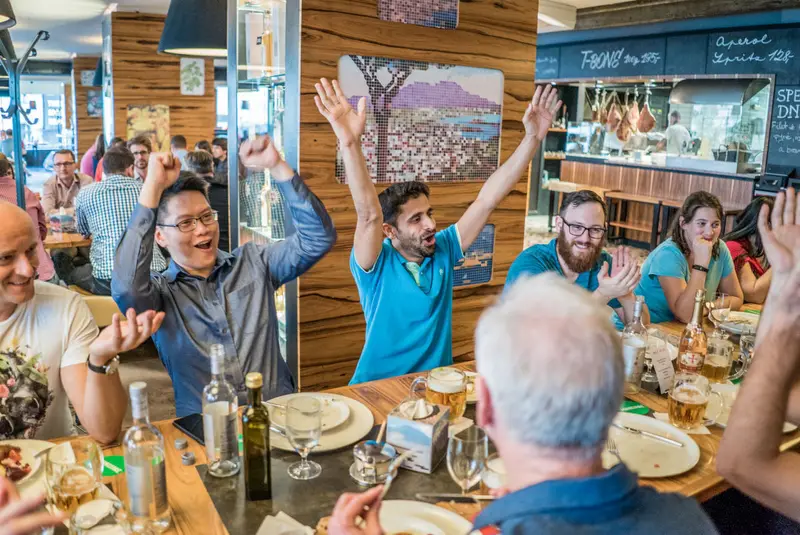
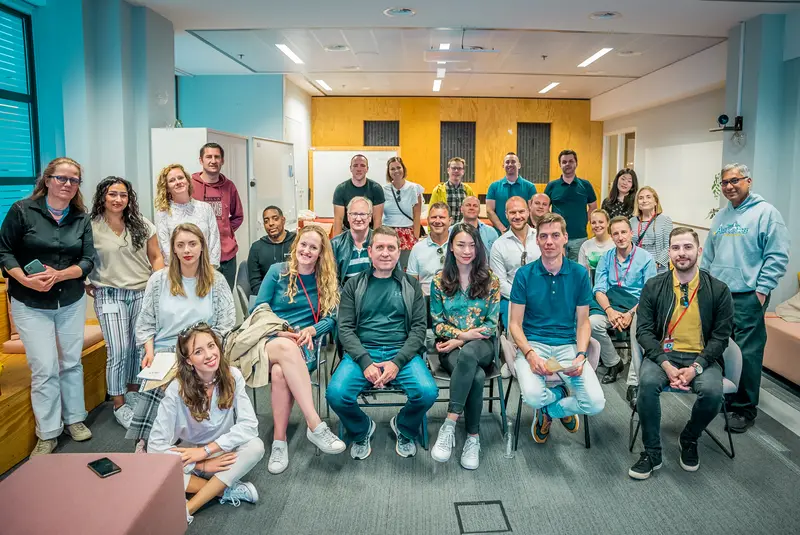
The practical process: share a participant list with department and level data 10 days before the event. We generate a draft team composition based on your parameters. You review and flag any specific adjustments (reporting lines to separate, known tensions to avoid). Final composition is confirmed 5 days before the event. For the Booking.com event, deliberate composition was the single most-commented factor in post-event feedback.
Logistics: what you control, what we handle
For groups of 100+, clear responsibility split prevents the most common failure modes:
| Your responsibility | Our responsibility |
|---|---|
| Participant list with department/level data (10 days before) | Route design and parallel route coordination |
| Transport to the start point | Game master staffing (1 per 2–3 teams) |
| Internal communications and calendar invites | Team composition draft and review |
| Dress code briefing to participants | Materials, app setup, score tracking |
| Catering arrangements after the event | Timing management and reveal facilitation |
| Designated internal coordinator on the day | Weather contingency plan (agreed in advance) |
The most common logistics failure point for large groups: participants arriving in multiple waves from different locations, causing the briefing to start late and compress route time. Set a strict arrival deadline — typically 20 minutes before the briefing for groups of 100+ — and communicate it clearly in advance. We start on time regardless; late arrivals join their team mid-route.
For groups arriving by coach from outside Amsterdam, we recommend starting locations near the Museum Quarter or Leidseplein, which have accessible drop-off zones and short walks to the route start.
Budget considerations at scale
Large groups benefit from volume pricing. The per-person cost decreases as group size increases, making large-scale events significantly more cost-effective per head than the equivalent number of smaller events:
| Group size | Approx. cost per person | Routes needed |
|---|---|---|
| Up to 15 | €46–69 | 1 |
| 16–50 | €20 + base fee | 1 |
| 51–100 | €16 + base fee | 1–2 |
| 100–200 | ~€26 all-in | 2–3 |
| 200+ | Custom quote | 4+ |
For context, a group of 100 at ~€26 per person compares favourably with a mid-range Amsterdam restaurant dinner (€45–65 per person) or a hired venue for a company drinks event (€30–50 per person including staffing) — with significantly more actual interaction built in.
Add-ons (corporate branding, company quiz, values integration) are particularly cost-effective at scale. A custom-branded event for 100 people adds approximately €50 to the total — less than €0.50 per person. The full planning guide covers how to structure budget approval for large-group events.