Why most team building activities don't actually work
Ask HR managers what made a team building event genuinely effective and most will struggle to answer beyond "it was fun." The problem is that fun and effective are not the same thing — and in corporate team building, the gap between them is wide.
The distinction comes down to one question: does the activity require your team to work together, or does it merely give them an opportunity to do so? Most formats — bowling, go-karting, paint and sip, team dinners — fall into the second category. Your team is in the same room. They're enjoying themselves. But their individual performance has no bearing on anyone else's. You could swap half the group with strangers and the experience would be identical.
What psychology says about effective team building
Organisational psychologists call the key variable task interdependence — the degree to which team members must coordinate, share information and rely on each other to complete a task. Research consistently shows that higher task interdependence produces:
- More spontaneous communication (people talk because they have to, not because they feel socially obligated)
- Clearer role emergence (the analyst, the creative, the navigator appear naturally — without anyone assigning them)
- Shared episodic memory (teams recall a complex shared challenge far longer than a passive shared experience)
- Mild stress followed by collective relief — the neurological sequence that forms strong social bonds
A related concept is the natural interaction environment. In office settings, people are constrained by hierarchy, role expectations and physical layout. In an unfamiliar outdoor environment — one that's new to everyone simultaneously — those constraints dissolve. Seniority becomes irrelevant when nobody knows where the next checkpoint is.
Why bowling falls short as team building
Bowling is a good game. It is not good team building. The structural problem is straightforward: players take turns, scores are individual, and the outcome of your frame has no effect on anyone else's. Interaction happens by chance — a round of applause after a strike, some banter at the bar — but it's not built into the structure of the activity.
Office parties and team dinners have similar limitations. They're pleasant, but people naturally cluster into existing social groups. Newer colleagues, more introverted team members, and those outside the dominant social circle tend to spend the evening at the margins. No element of the format pushes anyone out of their comfort zone — or rewards them for doing so.
5 reasons Treasure Hunt works better than bowling
Treasure Hunt works as team building because its structure actively forces collaboration — unlike bowling or a party, where communication only happens by chance.
| Criterion | Bowling | Office Party | Treasure Hunt |
|---|---|---|---|
| Active collaboration required by structure | ✗ | ✗ | ✓ |
| Communication built into the activity | ✗ | by chance | ✓ |
| Everyone finds a natural role | ✗ | partially | ✓ |
| Breaks down hierarchical barriers | ✗ | ✗ | ✓ |
| Memorable shared experience | moderate | moderate | high |
| Skills transfer to the workplace | ✗ | ✗ | ✓ |
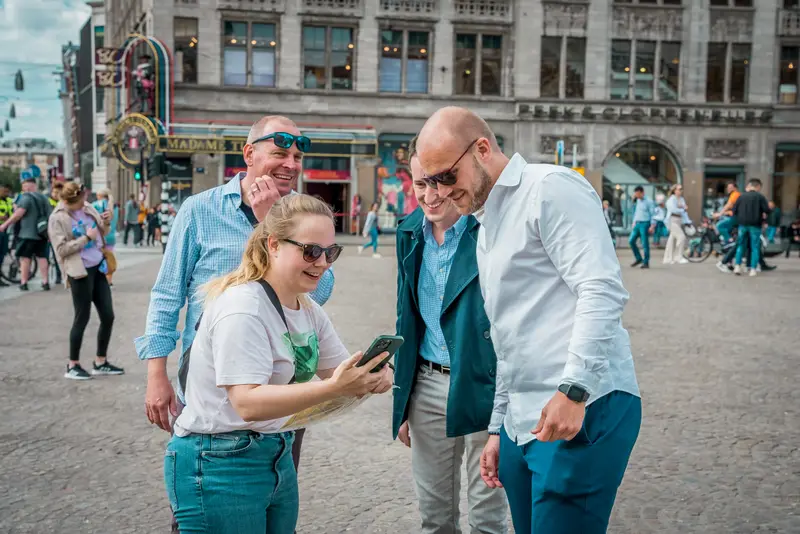
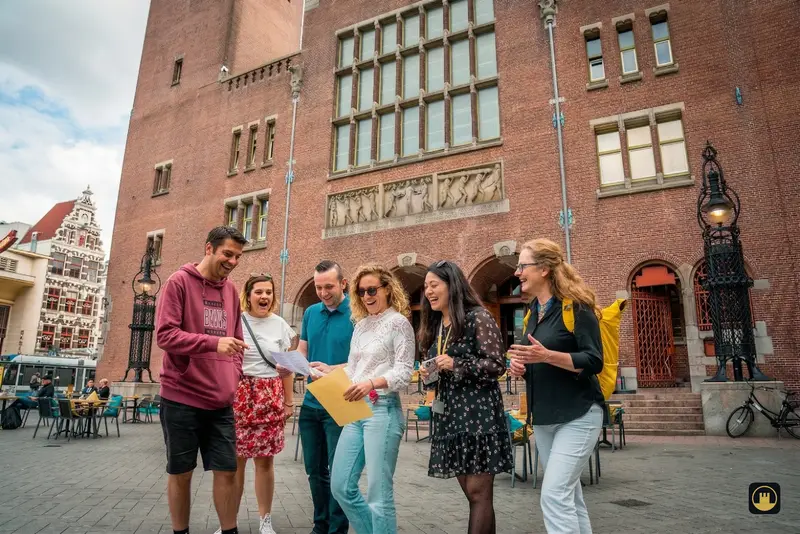
- It demands real collaboration. Without sharing information across the team, you won't complete the tasks within the time limit. Every member must contribute — there's no passive participation.
- Everyone finds their role. Navigators lead the route. Creatives crack the riddles. Analytical thinkers decode the ciphers. Observant members notice what others miss. All of these roles matter equally — and they emerge naturally, without facilitation.
- The environment removes hierarchy. On the streets of Amsterdam, nobody knows who the director is. The most useful person at any moment is whoever has the relevant skill for the next challenge — not the most senior person in the room.
- The challenge is genuinely shared. When your team cracks a difficult task, everyone feels it at the same moment. That collective relief is the neurological foundation of lasting team cohesion. It cannot be manufactured — it has to be earned.
- The experience is memorable. Teams consistently report referencing their Treasure Hunt months later. "Remember when we completely missed that clue on the Herengracht?" is worth more as a workplace bond than any amount of forced conversation at a bowling alley.
Why Amsterdam is the ideal setting
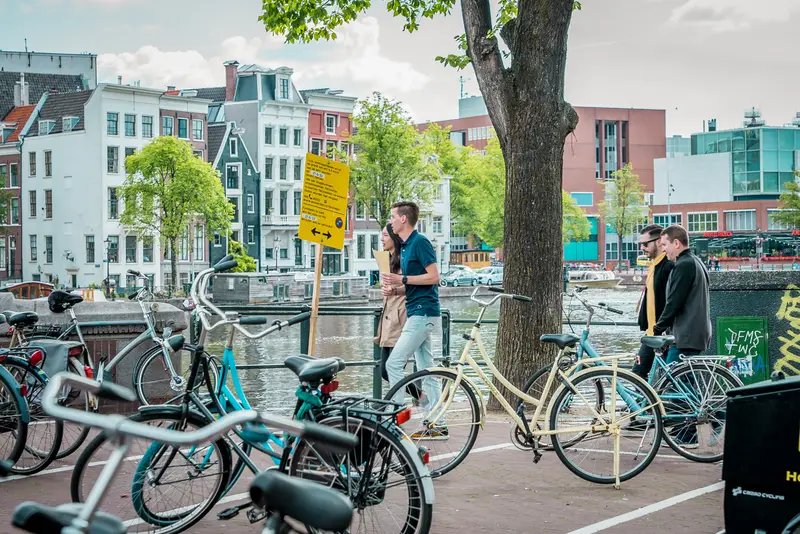
Amsterdam is not just a backdrop — it's an active component of the challenge. The city's concentric canal ring creates natural zones that feel distinctly different as teams cross each bridge. Centuries of merchant history have left hidden courtyards (hofjes), houses with coded gable stones, and architectural details that reward careful observation.
Unlike an escape room (where the setting is entirely artificial) or a conference room activity (where the setting is completely irrelevant), a Treasure Hunt uses Amsterdam itself as the game board. The city's real history becomes the content of the challenge. Teams leave knowing something genuine about the place they work in or are visiting — and that shared discovery belongs to them specifically.
Want to know which parts of Amsterdam work best as a route? Read our guide to the best team building locations in Amsterdam.
The introvert problem — and why Treasure Hunt solves it
Most team building formats quietly disadvantage introverted participants. The loudest person wins at improv workshops. The most physically dominant person leads at sports days. But a Treasure Hunt creates multiple simultaneous problem types — logical, spatial, observational, creative, navigational — so different personalities lead at different moments.
The quietest person on your team is often the one who notices the detail everyone else walked straight past. In a Treasure Hunt, that moment of recognition has direct consequences for the team's score. It matters. That is a fundamentally different experience from politely cheering at someone else's bowling strike.
What this means for your team building event
The format matters most for teams where cohesion is genuinely at stake: newly formed teams who haven't yet found their working rhythm, remote teams meeting in person for the first time, departments navigating a merger or restructure, or large groups where certain subgroups don't naturally mix.
For all of these scenarios, an activity that requires collaboration — rather than one that merely permits it — produces measurably different outcomes. A Treasure Hunt through Amsterdam's canal streets provides the combination of task interdependence, shared challenge, mild stress and collective relief that research shows creates bonds that outlast the event itself.
The bowling alley provides none of those things. It's not a criticism — it's just a different category of experience.
Not sure how to structure the day around it? See our complete guide to planning a corporate team building event in Amsterdam.